Guide to Accessioning Living Collections
Practical guidance for documenting and managing living plant collections
The Guide to Accessioning Living Collections provides a practical framework for documenting and managing living plant collections. Good documentation enables plants to be traced throughout their life cycle, supports collection management and decision-making, and helps gardens understand the conservation value of their collections.
The guide covers:
- why living collections should be documented
- acquisitions and accessions
- accession numbering
- provenance
- stocktaking and deaccessioning
- the key fields needed for useful and traceable accession records
- how accession data can contribute to wider conservation.
Developed with botanic gardens and collections specialists from around the world, the guide brings together practical experience and provides an adaptable framework that can be used alongside different collections management systems and practices, while setting a set of concepts and standards.
Supporting good collections management and BGCI Accreditation
The guide also supports gardens working towards BGCI Botanic Garden Accreditation. BGCI’s Accreditation Standards recognise documented living collections as a fundamental component of a botanic garden. The guide is not an accreditation standard. It provides practical guidance to help gardens develop and review their collections policies, accessioning procedures and documentation practices in support of good collections management and BGCI Accreditation.
From good documentation to global conservation
A well-documented accession is valuable to an individual garden. When comparable information is shared across institutions, it becomes a much more powerful resource. PlantSearch provides a global platform for sharing information about living collections. PlantSearch Accessions extends this to accession- and specimen-level information, enabling gardens to share richer information about the origin, history, location and status of their collections.
The Guide to Accessioning Living Collections complements PlantSearch Accessions by explaining the key accessioning concepts and terminology used in the tool.
Together, good documentation and shared data can help identify conservation gaps, inform acquisition priorities, support research and restoration, and strengthen collaboration between gardens.
As highlighted in BGjournal 23.1, Living Collections and Data in Botanic Gardens, “data is as vital as the plants themselves.” Improving how living collections information is recorded, shared and used can strengthen the collective contribution of botanic gardens to safeguarding plant diversity.
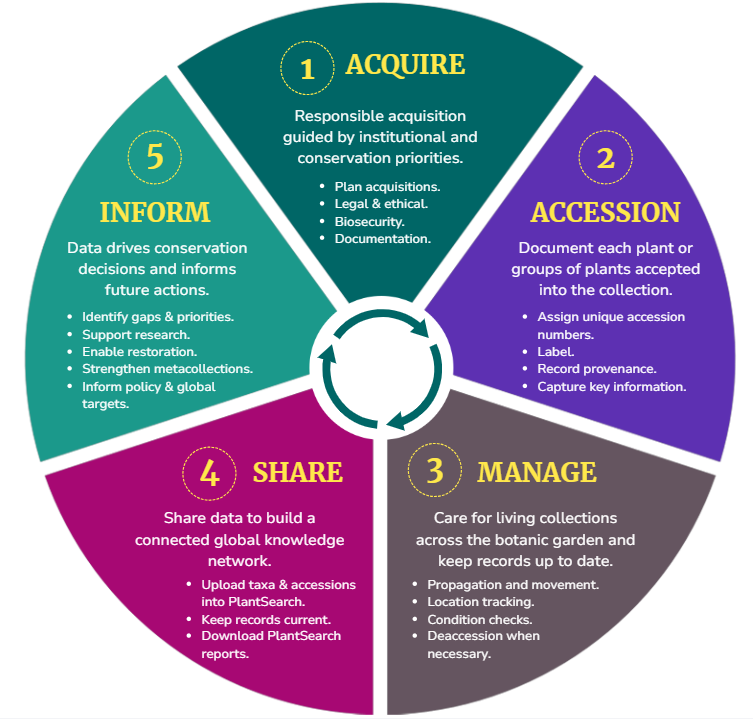
This guide was made possible with the financial support from the Leon Levy Foundation, the Walder Foundation and BGCI members who support BGCI’s unrestricted income.
Associated resources
-
Guide to Accessioning Living Collections
Services for Botanic Gardens / Publication / English -
Guide to Accessioning Living Collections - Appendices
Services for Botanic Gardens / Publication / English -
Guía para Accessionar Colecciones Vivas
Services for Botanic Gardens / Publication / Spanish -
Guía para Accessionar Colecciones Vivas - Apéndices
Services for Botanic Gardens / Publication / Spanish
Discover our data
BGCI Databases
Explore BGCI's suites of databases to help plant conservation worldwide. Upload your data!
Become a Member
Be part of the largest network of botanic gardens and plant conservation experts in the world by joining BGCI today!