New IPSN Resources!
-
Region
Global -
Programme
International Plant Sentinel Network -
Workstream
Saving Plants -
Topic
Plant Conservation -
Type
News -
Source
BGCI
News published: 02 April 2026
The International Plant Sentinel Network (IPSN) has released a new set of posters and factsheets to help spotlight emerging plant pests and diseases.
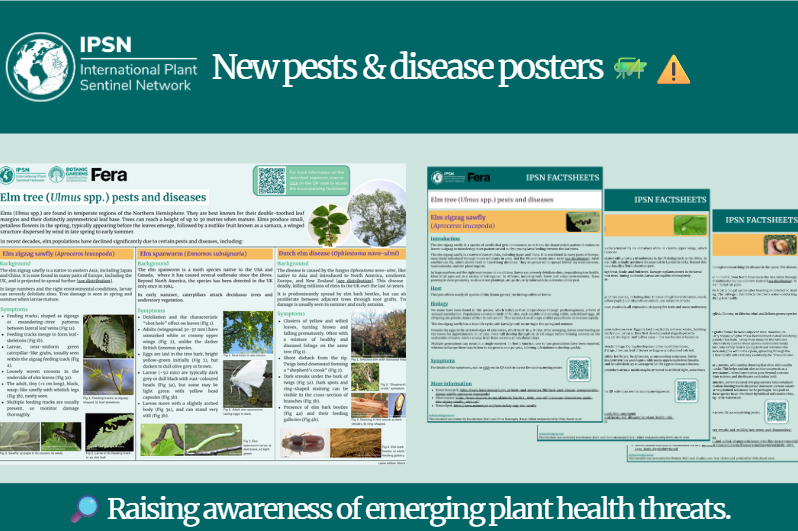
The latest set of published resources includes three new posters, each dedicated to a host plant, a disease, and a pest respectively. These posters are accompanied by detailed factsheets, which are designed to support the visual identification of target organisms, providing further background and guidance. Both resources are linked to each other via a QR code. This year’s posters and factsheets focus on:
- Elm tree (Ulmus spp.) pests & diseases: three pests and diseases (elm zigzag sawfly, elm spanworm, and Dutch elm disease) that have ravaged elm populations globally, notably Dutch elm disease, which has killed millions of trees in the UK over the last 50 years.
- Root and Butt Rot (Heterobasidion irregulare): a fungal pathogen afflicting coniferous and deciduous trees, which currently poses a threat to European forests.
- Two-spot cotton leafhopper (Amrasca biguttula): a rapidly expanding pest, which is currently decimating important crops from cotton to okra and aubergine in warmer countries.
You can find past posters and factsheets on the IPSN website:
The IPSN has also issued a new organism alert for the Argentine Ant (Linepithema humile), a pest listed as among the 100 of the World’s Worst Invasive Alien Species by the Invasive Species Specialist Group (ISSG). It poses a serious threat to plant and ant species worldwide, forming mutualistic relationships with honeydew-producing insects that devastate native ecosystems. Tackling this growing threat is vital to ensure global plant health.
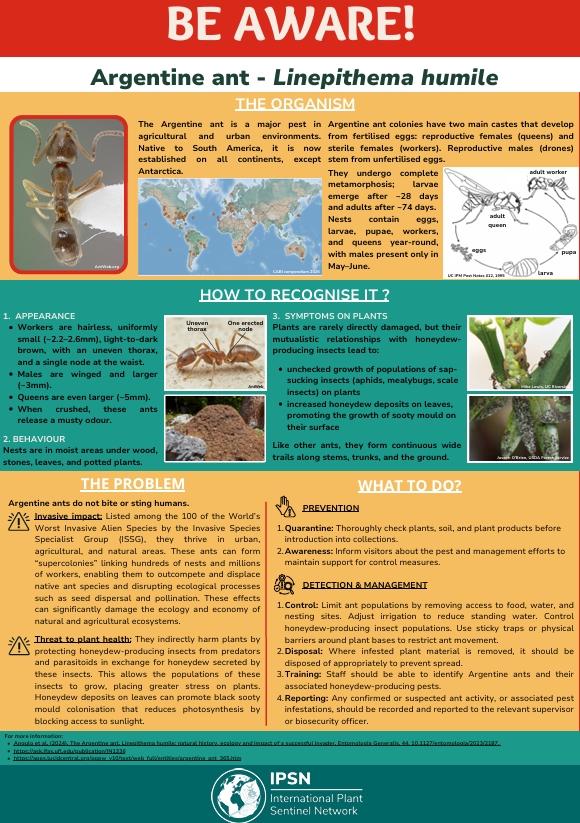
You can download our Argentine Ant alert poster here.
We encourage you to print and display these resources in your organisation—this will help raise awareness among staff and visitors. Please do also share them with any colleagues or partners who might find them valuable.
Happy reading!
Become a Member
Be part of the largest network of botanic gardens and plant conservation experts in the world by joining BGCI today!
BGCI Databases
Explore BGCI's suites of databases to help plant conservation worldwide. Upload your data!