New Guide to Accessioning Living Collections Published
-
Region
Global -
Programme
BGCI -
Workstream
Sharing Knowledge and Resources -
Topic
Services for Botanic Gardens -
Type
News -
Source
BGCI
News published: 20 August 2026
BGCI has published a new practical guide to help botanic gardens strengthen the documentation and management of their living collections and help standardising vocabulary and processes across the community.
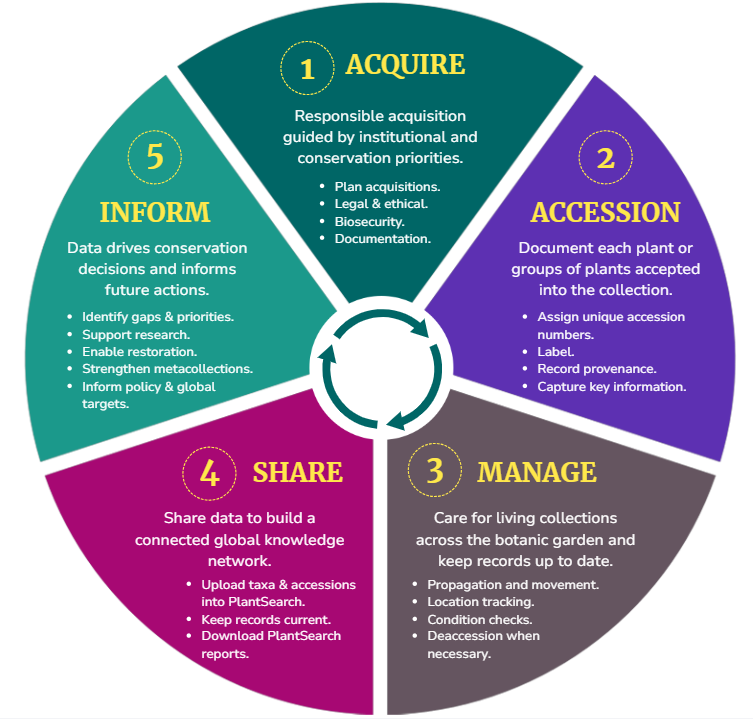
Living collections are at the heart of botanic gardens’ work in research, conservation, education and display. But their value depends not only on the plants themselves, but on the information associated with them. The new Guide to Accessioning Living Collections, developed by Patricia Malcolm and Noelia Álvarez de Román, with botanic gardens and collections specialists from around the world, provides practical guidance on how plant material can be documented from acquisition through accessioning and ongoing collection management.
The guide covers the fundamentals of accessioning, including what constitutes an accession, how accession numbers work, recording provenance, stocktaking and deaccessioning. It also introduces the information needed to create traceable and useful accession records and explains how these records can contribute to wider conservation efforts.
From individual records to a global resource
The publication comes at an important time for living collections data. In June 2026, BGCI released PlantSearch Accessions, a major enhancement to PlantSearch that enables gardens to manage and share accession- and specimen-level data. The new functionality means gardens can move beyond simply recording which taxa they hold to documenting individual accessions, including information about provenance, origin, location and status.
The Guide to Accessioning Living Collections provides the practical foundation for using this functionality effectively.
“Data is as vital as the plants themselves.”
This was one of the key messages emerging from BGCI’s recent Living Collections and Data in Botanic Gardens issue of BGjournal, which highlighted the growing importance of high-quality data, shared standards, capacity building and interoperable systems for the future of living collections.
By documenting collections consistently and sharing information through platforms such as PlantSearch, individual garden records can contribute to a much larger picture—helping identify conservation gaps, inform acquisition priorities, support research and restoration, and strengthen collaboration between institutions.
Available now
The Guide to Accessioning Living Collections is available in English and Spanish, with accompanying appendices providing additional practical resources.
We encourage botanic gardens and other institutions responsible for living collections to use the guide as a starting point for reviewing their own accessioning and documentation practices.
This guide was made possible with the financial support from the Leon Levy Foundation, the Walder Foundation and BGCI members who support BGCI’s unrestricted income.
Become a Member
Be part of the largest network of botanic gardens and plant conservation experts in the world by joining BGCI today!
BGCI Databases
Explore BGCI's suites of databases to help plant conservation worldwide. Upload your data!