Plane Lace Bug: A Summer-time Hunt for a Micro-menace in London Streets
-
Country
United Kingdom -
Region
Europe -
Programme
International Plant Sentinel Network -
Workstream
Addressing Global Challenges -
Topic
Plant Conservation -
Type
Blog -
Source
BGCI Partner
News Published: 18 December 2025
Guest blog contribution from Amirah Nigoumi from Forest Research, UK.
Taking a ride on the top deck of a quintessentially British London red double decker bus can sometimes get you into the news!
This is exactly what happened to an unassuming commuter on a warm day in July 2024. The passenger, a staff member of London’s world-famous Natural History Museum, noticed a tiny white bug on their backpack. Intrigued as they were, they quickly uploaded an image of the insect into their recently opened ‘iNaturalist’ account. Within a matter of days, and after some initial investigative questions, the image was tentatively identified by a staff member from Defra (Department for Environment, Food & Rural Affairs) as being an insect known as Plane lace bug (Corythuca ciliata), which had not been recorded in the UK since 2006.
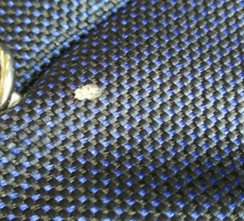
A hitch-hiker from North America
Originally from North America, Plane lace bug (PLB) has spread widely across Europe since it was first recorded in Italy in 1964. Despite its success elsewhere, the UK has only ever experienced one known, localised incursion. In 2006, PLB was detected outside London, triggering a targeted eradication and surveillance programme. Follow‑up work over subsequent years found no evidence that the insect had persisted.
For 18 years, the UK was therefore believed to be free of Plane lace bug. That assumption changed with the potential find in the Royal Borough of Kensington and Chelsea, West London.
Escalating the response
Following the July 2024 report, consultations between UK government agencies were quickly escalated. Plant health inspectors from the Forestry Commission (FC), Forest Research (FR) and the Animal and Plant Health Agency (APHA) were deployed to survey London plane trees (Platanus × hispanica) on streets and in parks around the initial location.
These inspections confirmed that a lace bug species was indeed present. Insect samples were rapidly returned to Forest Research’s quarantine laboratory at Alice Holt, Surrey. Later that same afternoon, microscopic examination confirmed the identity: Plane lace bug (Corythuca ciliata).
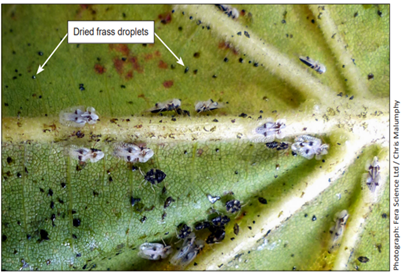
Masters of urban hitch-hiking
Plane lace bugs (PLB) are tiny, delicate insects that spend most of their lives feeding quietly on the underside of plane leaves. While largely sedentary, they are highly effective hitch‑hikers, easily transported on clothing, bags, vehicles and public transport.
High footfall and heavy traffic near the initial detection site may help explain their presence. In response, early surveillance focused on plane‑lined streets in areas such as King’s Cross in North London—home to a major national rail hub—and the South Bank in central London, an area characterised by dense visitor numbers, restaurants, theatres and museums.
By mid‑September 2024, Defra confirmed publicly that Plane lace bug had been found on plane trees in central London. It emphasised that although PLB is not a regulated pest, its presence would continue to be monitored closely. Surveillance was subsequently expanded to cover almost 300 square miles of Greater London, reflecting the widespread distribution of plane trees across the capital.
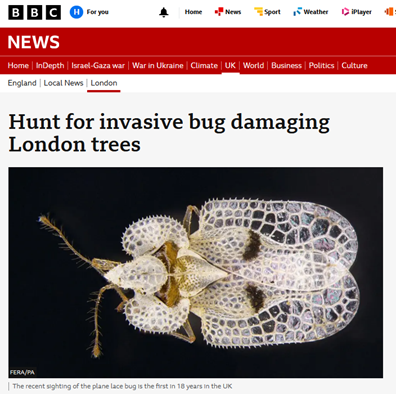
A coordinated survey effort
Staff from the Forestry Commission (including contractors), Forest Research and local council Tree Officers were deployed alongside specially trained volunteers from the citizen science project Observatree. Together, they carried out systematic surveys across London.
More than 1,600 individual plane trees were inspected across a wide range of urban environments. Surveyors used visual inspections, often aided by binoculars, to look for signs of PLB activity, such as frass droplets, insect congregations and leaf discolouration. Any suspicious findings were immediately escalated to Forest Research staff for confirmation.
At the same time, specially trained Observatree volunteers across the rest of the UK were asked to survey plane trees in their local areas, which resulted in no evidence of Plane lace bug outside London.
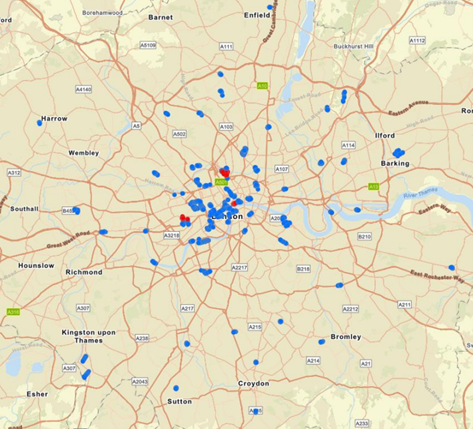
What happens next?
During this period of intensive surveillance, no additional London locations were found to be harbouring Plane lace bug populations. These findings were reported back to Defra and in 2024, Defra confirmed that as PLB is not a regulated pest in either the UK or the European Union, there is no statutory requirement to take formal control action.
However, this is not the end of the story.
Dedicated citizen scientists from Observatree, based across the UK, continue to survey their local plane trees. Any findings—including reports of healthy trees—are submitted via TreeAlert, the UK’s tree health reporting platform managed by Forest Research and supported by the UK’s devolved governments.
Submissions to TreeAlert are assessed by Forest Research’s entomology and pathology diagnostic teams, who provide diagnoses wherever possible. In some cases, site visits are arranged so that closer inspections and samples can be taken.
Increasingly, this work also incorporates public observations submitted through other biological recording platforms. As this case has shown, species not previously thought to be present in the UK can sometimes be detected first by a vigilant member of the public—perhaps even during an ordinary bus journey through London.
Further reading
– Platanus lace bug (Corythucha ciliata): A newly reported pest in Central London – Anna Platoni, Sarah Facey (FR), Chris Malumphy (Fera)
– Plane lace bug (Corythucha ciliata) – Forest Research
– Plane Lace Bug: A Delicate Micro Menace Concealed in the City – Observatree
About the author
During her professional career, Amirah has lived and worked in both the UK and New Zealand (2007-2020), in a wide variety of sectors: from working as an assistant conservator at the Hunterian Museum, to being a scenic artist in repertory theatre, to working as a forensic practitioner in the Metropolitan and New Zealand Police services, to breeding the bumble bee Bombus terrestris for commercial pollination and to administrative work in HM Land Registry.
Now as diagnostician in Forest Research’s advisory entomology team at Alice Holt Research Station, Amirah applies her plethora of experience to support tree health diagnostics of insect pest species and undertakes associated quarantine laboratory and field work, as well as assisting in training and trade events.


Become a Member
Be part of the largest network of botanic gardens and plant conservation experts in the world by joining BGCI today!
Conservation Action Tracker
BGCI’s Conservation Action Tracker provides information on conservation actions for tree species.