Education Grantees 2026: The Garden as a Climate Refuge (Colombia)
-
Status of project
Ongoing -
Region
South America -
Country
Colombia -
Programme
International Day of Education -
Workstream
Addressing Global Challenges Through Public Engagement -
Topic
Public Engagement -
Type
Grant
Grant blog published 13 May 2026
International Day of Education Grants
To celebrate International Day of Botanic Garden Education, and the recently launched Declaration of Intent on Climate Action Education, BGCI and the Korea National Arboretum provided a number of grants to BGCI members undertaking education activities aligned with the climate declaration.
This blog provides an overview of one of the projects funded – Quindío Botanical Garden‘s The Garden as a Climate Refuge: Participatory creation and implementation of a playful educational tool for understanding the relationships between biodiversity and climate action in the botanical garden.
The project
In a world where climate change is increasingly shaping everyday life, botanic gardens are being called to go beyond conservation and become active spaces for education, resilience, and social transformation. From the heart of Colombia’s Coffee Cultural Landscape, the Quindío Botanical Garden leads an initiative that responds to this challenge by connecting biodiversity, community, and climate action through lived experience.
“The Garden as a Climate Refuge” is an educational initiative designed to strengthen understanding of the relationships between local biodiversity, ecosystem services, and climate action. Through participatory, experiential, and playful methodologies, the project goes beyond teaching concepts—it invites participants to experience them.
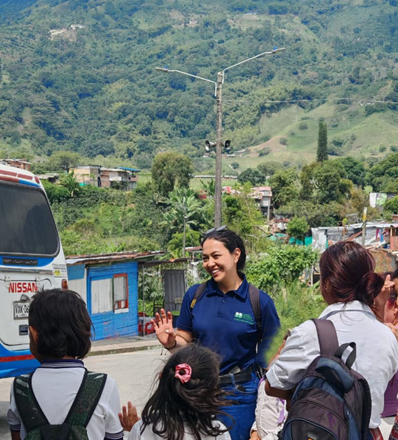
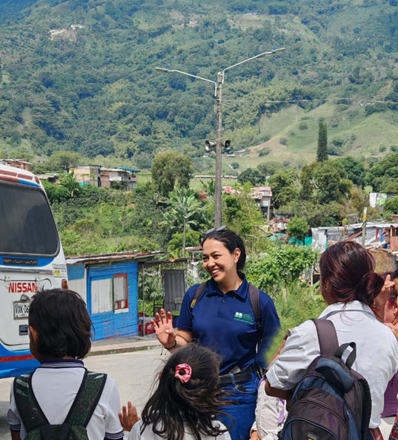
The initiative engages 20 children between the ages of 9 and 12 from Barrio Lincoln in Calarcá (Quindío), a community facing socio-environmental vulnerability. Despite living close to the Botanical Garden, many families have had limited access to continuous educational processes, particularly in climate-related topics. However, the project builds on an important foundation; participants have previously been involved in environmental education programmes led by the Garden, allowing for continuity and deeper learning.
At the core of the project is the development of an innovative educational tool that integrates science and play. This tool includes a biodiversity identification system featuring 75 species of flora, fauna, and fungi from the sub-Andean forest, as well as a set of connectivity networks that explain how these species contribute to key processes such as thermal regulation and carbon storage.
The implementation will take place through an experiential festival held in the framework of the International Day of Education in Botanic Gardens. During a four-hour session, families will take part in a guided learning journey that transforms education into a direct experience with the territory.
The experience begins with a thermal perception route, where participants compare the heat of the urban environment with the microclimate of the forest. Through this sensory exercise, they understand how biodiversity regulates temperature and contributes to well-being, recognizing the Garden as a true climate refuge.
Participants then move into Level 1: Biodiversity recognition, a dynamic activity where families identify plant, animal, and fungal species using a game-based approach. This stage strengthens observation skills while fostering a meaningful connection with local biodiversity.
In Level 2: connectivity networks and climate resilience, learning evolves into a systemic understanding. Families work together to solve climate challenges by building ecological networks, discovering how interactions between species contribute to territorial resilience. Complex concepts such as seed dispersal, the role of fungi in soil systems, and seasonal cycles become tangible and accessible.
The process concludes with a space for dialogue and co-creation, where participants collectively define pathways for local climate action. This moment transforms knowledge into commitment, encouraging both children and families to recognize themselves as active agents in climate mitigation and adaptation.
A key strength of the project is its emphasis on impact measurement. Through the MUEVE-JBQ evaluation model, learning outcomes will be assessed before and after the experience, allowing the team to measure changes in knowledge, perceptions, and attitudes toward climate change. This approach ensures that the initiative is not only educational but also evidence-based and replicable.
Beyond its local implementation, the project has a global vision. The methodology will be documented in a transfer manual to be shared with the BGCI network, enabling other botanic gardens to adapt and replicate the experience in their own contexts. In this way, a local initiative from Quindío has the potential to inspire global action.
“The Garden as a Climate Refuge” is also a commitment to equity. By working with vulnerable communities, the project promotes inclusive and accessible environmental education. Here, children do not simply learn about climate change—they begin to see themselves as capable of leading change within their own territories.
In the face of urgent global challenges, this initiative demonstrates that education—when rooted in experience, territory, and community—can become a powerful tool for building climate resilience from the local to the global level.